
About the Artwork:
Noura Alhariri
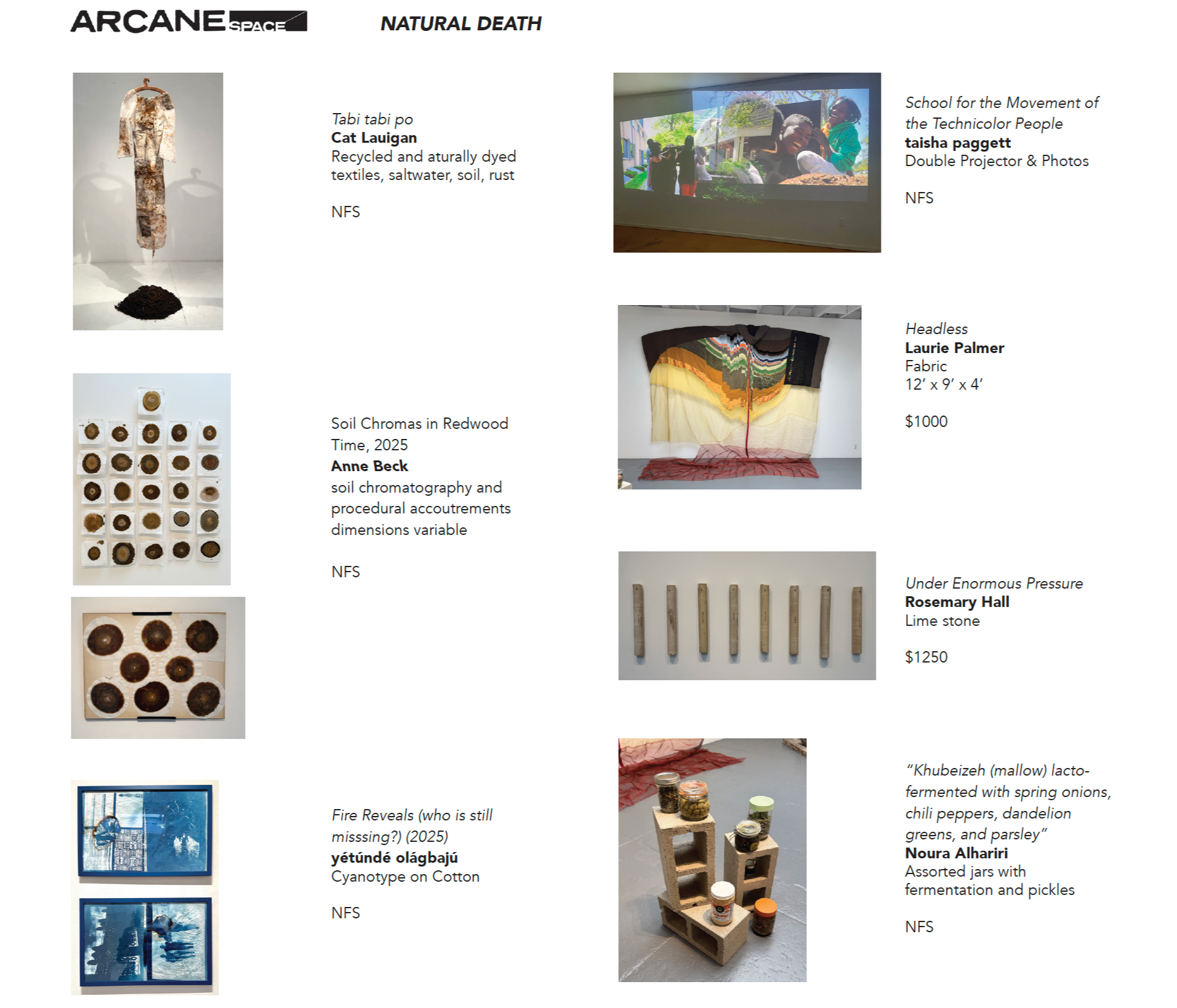
“Khubeizeh (mallow) lacto-fermented with spring onions, chili peppers, dandelion greens, and parsley.
Khubeizeh (mallow) grows in crowded knee-high bursts after any rain. It’s an ancestral wild green in Palestine, foraged and eaten for generations. During the Israeli genocide in Gaza, khubeizeh has been a famine food for Gazans, gathered and prepared when it can be found as one of the only available sources of nutrition. Here, this delicate plant has been collected locally, pressed, and brined. In the transformative process of lacto-fermentation, khubeizeh is held in a new alternate timescale, delaying its loss from us.”
Taisha Paggett
my contribution to natural death revisits an earlier collaborative project*, School for the Movement of the Technicolor People (2015–2019), created during a time of heightened racial reckoning. photographs from the project’s “Demonstration Score” series and videos of the dancers* communing with black panels unfold simultaneously as rehearsal, experiment, performance, demonstration, and ceremony.
evoking both the body and the black mirror described by Walter Mignolo as a reflection between worlds that exposes the fractures of colonial modernity, the panels extend, mourn, and awaken black beingness beyond the un-“natural death” of state-sanctioned violence. in the overlaid video processions (one filmed in Los Angeles, the other in Toronto) a shared frequency emerges, linking the two sites across turtle island in a field of continual becoming.
body / land. object / subject. life / death. black death / black dance. being / not being. each one and the same, perpetually arising.
[photographs and video by Ashley Hunt. panels by Kim Zumpfe. Dance company members of WXPT (we are the paper, we are the trees) in the videos and photographs: Ella Cooper, Rodney Diverlus, Bishara Elmi, Aisha Sasha John, Ashley Perez, Danielle Smith; Terrell Brooke, Kofi Wade, taisha paggett, Erin Christovale, Brittani Broussard, Kloii Hollis, Maria Garcia Maea, and Meena Murugesan.
Anne Beck
This array of soil chromas comes from deep inside the cosmologies of Redwood Time — a radical re-envisioning of the Redwood Round monument that stands in the center of Fort Bragg. This once-living monument, like its many counterparts throughout the Redwood Empire, bears a dendrochronological timeline with a singular canonical narrative. In Redwood Time, the narrative expands to hold a multiplicity of perspectives, including that of the soil beneath our feet and within our roots. In Redwood Time, a community gathers to walk around this place we know now as Fort Bragg. We are collecting soil, and other materials, to conjure the mysteries of the round — the esoteric aspects of the life, death and companions of the Redwood we know now as the C.R. Johnson Memorial Tree. In Otis Johnson Park, Arianne takes the first specimen from the creek bed, while Matilda and Bijou are gently collecting from amongst the duff below nearby redwoods. Up the hill to the north, Colleen gathers from under a tan oak, will it be different? Also, from a draw of water muddying the ground, and from a charred stump in the middle of a fairy ring. Shoshana and I stop at the train tracks to collect a rich sample of diesel blackened soil. We dig from several spots around the fenced perimeter of the mill site and a rogue incursion beyond the fence yields a couple more. Finally, from the charred remains of burned ice plant, and from three areas, distinct from one another by the varying presence of iron, around the formerly trash-filled cliffs of glass beach. The sun has set now, we are late. A pick up truck magically appears. We pile in, attuned to the work at hand, some mission accomplished, awaiting conversation with the animate earth. Back at the Larry Spring Museum, turned Mysteries Lab, we begin processing. Soil Chromatography appears simple, yet it reveals complexities that resist full explanation, despite our scientific method. It was once used to measure soil health before more precise laboratory tests were introduced, though reading a chroma is largely an intuitive process — more sensation than direction. The heaviest particles precipitate first, and lightest last. Complexities in channels and spikes indicate rich, healthy, complex soil. We see no difference between the diesel-rich soil and the redwood duff. Is this a photographic image of sludge - diesel or duff? We do not know. We need more time. We need more redwood time. The experiment is still underway. Will always be underway if we allow ourselves to be open to the poetic interconnectedness of all things.
Jas Lin
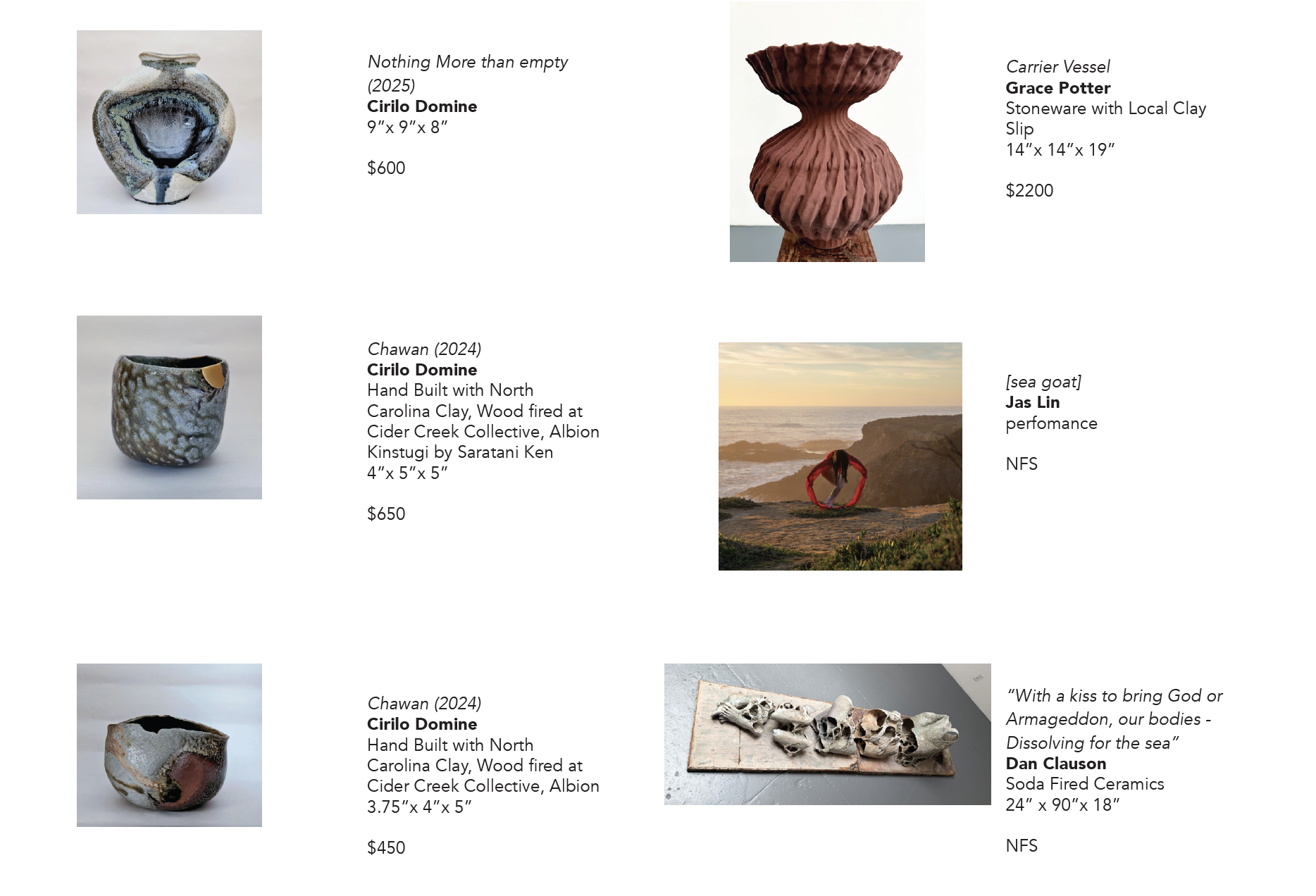
The sea goat mirrors the land in a reciprocal topography, dwelling at the threshold between ocean and mountain, night and day, death and life, the unseen and the seen. It finds resonance in stillness and slowness, listening as bells dissolve into the wind and become a continuous reverberation of lineage and futurity. Lin’s red sleeves unspool time, stitching together cycles of loss and fertility, holding and releasing, remembering and resurfacing. Inspired by the rising and falling of the tides and the mythical goats of Goat Island that belong(ed) to no one, [sea goat] initiates a passage through the arched gateways of the Mendocino Headlands.
Score:
I. Go Deep, and Be Spat Out
II. The Jagged Grief of Being Alive
III. To See Through One Eye
mask by maya
live performance footage filmed by Peter Ferris Rosati
Jules Pierce
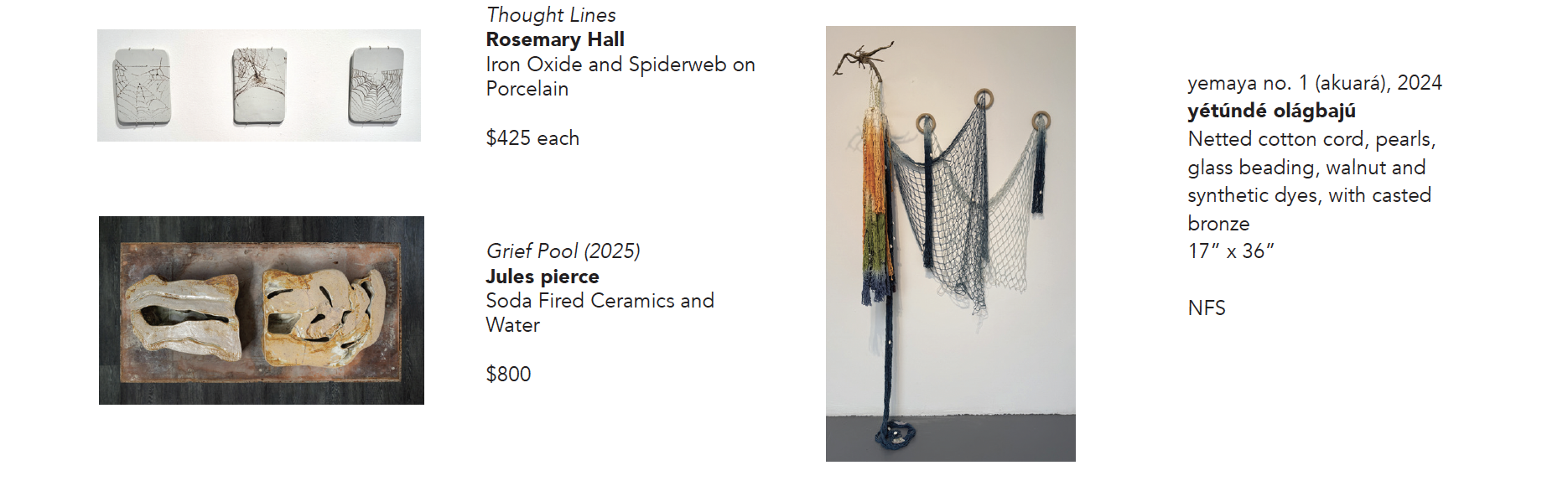
Dedicated to the duration of queer devotion, Grief Pool places the figure into the ancient relational landscape of rock and water. Mirroring formations that gently take in tides, carry water in their basins, and slowly release it back to the sea, this piece speaks to the calm holding space between cliff and water, reflecting the places that we carve out to preserve our queer lives.
Laurie Palmer
Based on a cross-sectional map of the fracked New Albany oil shale formation in Southern Illinois, Headless is a hooded cloak for a giant with a broken back and a missing head, a version of human hubris that doesn’t know what it is doing, doesn’t know that its own body is continuous with the body of the earth that it is destroying, and with the bodies of other beings who are broken by the same cruelty and violence. The piece was created in memoriam for my brother David, who lived with a broken back and a developmental disability, and who died on election night in November, 2016.
Rosmary Hall
Thought Lines gathers from orb weaver spiders and the architectures they leave suspended in the world. Different webs were misted with iron oxide and captured on clay tablets. Each tablet becomes a record of an encounter. The web is a dynamic species–habitat assemblage, weaving body, material, surface, architecture, and time together. The abandoned web becomes a material memory and a diagram of spider intelligence, attunement, and labor continuously re-made.
Cat Lauigan
Tabi tabi po by Cat Lauigan (in collaboration with Rino Kodama)
A shroud sewn from remnants — recycled cloth, naturally dyed fragments that I stitched onto my lap as we drove towards the coast. On the front, a poem by Làwû sent to me last year; on the back, a poem I wrote back to you after your transition. Carried to the Mendocino coast, your shroud was bathed in saltwater. Rino found the perfect place and we laid it beneath the angel of animals that guards the Mendocino Art Center. With Matt and Rino, flowers gathered from nearby were pressed and rolled into its folds. A rusted chain wound around the fabric before it was returned to the earth. With some passing of time, Rino unearthed the shroud, now fused with soil and its memories, imprinting your piece into its timeline. An offering to you and those before as we say Tabi tabi po nuno, makikiraan po.
For questions please email: info.arcanespace@gmail.com