About the Artists for Natural Death
Dav Bell - Curator is an artist and arts organizer interested in collaborating with kind people to cultivate tangible and creative connections. Through encounter, relationship building, and humor, he sees art as a possibility for truth and reconciliation. He participates in gift-giving and is interested in how storytelling, lyricism, and craft can flourish in gift economies. He is committed to finding more ways we, as humans and other sentient beings, can thrive together. He holds a BFA from the University of California Los Angeles and an MFA in Environmental Art and Social Practice from the University of California Santa Cruz. He is the founder of the Los Angeles artists’ project Visitor Welcome Center (2015-2021) and co-founder of The Greenhouse Project, an inter-generational education space that centers art, food and climate justice, located in Santa Cruz, California, and is the Executive Director of the Mendocino Art Center.
Rino Kodama - Curator Currently based in Albion, California, I am a second generation Japanese American artist and writer. Where my practice begins with poetry to explore themes of grief and transformation, they merge into life size ceramic sculptures, a celebration of the more than human world, in constant relationship and learning from the regenerative life all around us. Collaborating with the elements of fire and earth, I use repetitive coil building techniques, where clay becomes a medium for protection, somatic processing, and ritual. My clay vessels are extensions of my genderqueer body, malleable, undergoing stages of transformation, the way clay goes from its original to fired form. My earliest collaborations are with my mother, Tomoko Kodama, a gardener and florist who regularly creates arrangements for the vessels I create, and who was the first person who showed me the importance of planting and nurturing beauty in our lives.
Outside of my ceramic practice, I find joy in working with other queer and trans artists searching and creating spaces of belonging. I am a co-editor of Letters to Home: Art and Writing by LGBTQ+ Nikkei and Allies, an anthology of works by Japanese American queer and trans folks and their families, on ways they have co-constructed community.
Kodama holds a BA from UCLA, and most recently attended the inaugural session of Schools of Salmon Creek, co-creating and learning with 5 other artists on Pomo land. They recently completed their School Guide position at Salmon Creek, stewarding the next cohort of artists to experiment and develop a connection to their bodies, land, practice, and each other. Kodama is currently a long term resident at Cider Creek Collective.
Noura Alhariri is a Palestinian artist, researcher, and cook. Across her multidisciplinary practice, food is held as a site of evidence: a sensory means of tracing preservation, separation, longing, and care. Positioning Palestinian food as a practice in world-making, she works across fermentation, writing, tending to land, communal meals, foraging, documenting indigenous food practices, photography, mycology, and heritage recipe collection. Her most recent work is in fermentation as a partner for grief.
She holds a Bachelor’s of Architecture with a focus on ecological design from the University of Oregon, with a minor in Art History. Most recently, she was an artist-in-residence in Pie Ranch’s Food Justice and Indigenous Foodways cohort. She is currently compiling and photographing an archive of orally narrated family recipes titled Yimkin.
Daniel Clausen is a Queer and Trans Artist focusing mostly in ceramics. Through ceramics they create bodily forms that resist the limitations of biological and systematic structure, to excavate/practice/conserve a language of Queer longevity, history, and interconnection.
From the University of Washington, Daniel holds a BA in Sculpture and a minor in Art History. They have had multiple solo exhibitions throughout the United States, and have received fellowships and residencies for their work in ceramics, drawing, and writing. They currently live and work among the oak trees of the Miwok, Pomo, and Wappo lands (Sonoma County)
Sarita Doe’s plein air painting and pedagogical practices are nodes within mycelium for planetary liberation. She collaborates with habitat and Indigenous sovereignty movements to dismantle anthropocentrism and grow the Ecocene. This is an imagined, emergent, and ancient-futurist geologic era to dismantle empire with Earth-centered rituals of reciprocity.
Native plants, watersheds, elders, and more-than-human species inform her natural pigment paintings with stories of traditional ecological knowledge, grief, and survival. Motherhood drives her desire to generate creative, educational, and economic shifts in culture from extraction to cultivation.
Sarita is co-founder of the DIY PhD and School for the Ecocene Cooperative, author of Textbook for the Ecocene, creator of the DIY PhD Activity Deck, and illustrator for Earth Doula by Queen Hollins. She received an MFA from UCLA in 2012 and was a recipient of the 2024 Cali Catalyst Award. Sarita has exhibited her work in New York, Los Angeles, Mexico, and San Francisco. She is currently based in Ohlone Lands, learning with her daughter, mountain apu, deer kin, chosen family, and Celtic-Andean ancestry.
Cirilo Domine - Philippine-born American artist Cirilo Domine's art practice is encyclopedic rather than serial. As a bridge builder, his work points to exchange, reciprocation, and return to the Philippines, Japan, and the United States. Domine negotiates, acknowledges, and reveals history's hurts. By recognizing patterns of absences and gaps, he consciously translates and mistranslates systematic virtues and perspectives to create new forms.
Domine's work is informed by the Urasenke School of Tea, where he has been a student for fifteen years. His ongoing study of tea culture has led him to a flow of overlapping genres and encouraged him to examine multiple areas of interest within tea. His art practice reflects this exploration, moving from one medium to another and linking overarching narratives.
His recent work focuses on the handmade tea bowl. Each piece is an essay, a meditation on the inside space and outside form that holds tea but also imagined as part of a bigger culture of sharing. Clay is chosen carefully, most are wood fired with unexpected effects produced by flame and chance. What comes from a collective effort - hard work and sweat, is unimaginable beauty that makes sharing tea all the more worthwhile.
Domine earned his Master of Fine Arts from the University of California, Irvine, in 1996 and his Bachelor of Arts from the University of California, Los Angeles, in 1993. Both degrees emphasized conceptual artwork heavily influenced by race and gender theory, which imbues his art. But working with one's hands is integral to his practice. As a child in the Philippines, Domine was absorbed in learning to sew, weave, crochet, and shape singular forms. Domine sees craft as his generational inheritance, and this remarkable gift of childhood training has influenced his technique and vision for over twenty-five years.
Rosemary Holliday Hall’s interdisciplinary practice explores relationships between ecological systems and built environments, questioning how we come to know and inhabit the world. She traces relational ecologies through sculpture, ceramics, installation, moving image, and sound. Her work fosters interspecies correspondence that challenges human-centered perception.
Hall holds an MFA from the School of the Art Institute of Chicago and a BFA from the University of California, Davis, where she also minored in Environmental Horticulture. Her work has been exhibited in both solo and group exhibitions across the United States and internationally.
She has been awarded residencies and collaborative science research fellowships: Nemeth Art Center, Taft Gardens Artist Researcher in Residence, Ex.Change Artists and Scientists on Climate Change in Chicago, the University of Chicago Art, Science & Culture Grant, Leroy Neiman Oxbow Fellowship. In 2025–26, Hall will serve as artist-in-residence at the National Center for Ecological Analysis and Synthesis (NCEAS) in Santa Barbara, where she will develop new work in collaboration with ecological researchers at the center
Cat Lauigan (Huichin/Oakland, CA) is a Filipinx artist, musician, DJ, cultural worker, and seamstress for the underground. Her multidisciplinary practice spans sound, installation, poetry, performance, and wearable forms dyed with natural pigments, moving between the material and the unseen. Rooted in an investigation of the immaterial, her work explores transformation as an embodied, intuitive process, tracing the interconnections between self, place, and ancestral echoes.
Lauigan frequently engages in collaborations and community-based projects that unfold across renegade raves, clubs, galleries, and festivals, creating spaces for listening, movement, and shared experience. As DJ NFS (Not For Sale), she constructs sonic worlds that evoke the esoteric and unseen, weaving contrasting tempos and textures into immersive sets. Performing as csyrin, vocalist and sound artist of the experimental trio S’hells Gate, she fuses voice, poetry, electronics, and field recordings into compositions that trace spirit, texture, and transformation.
She is also the co-founder of CONE SHAPE TOP, an Oakland-based label, record shop, and platform that celebrates underground culture and fosters cross pollination in experimental sound and collective listening.
Jas Lin (Los Angeles) stages exorcisms and tantrums for purging choreographies of the learned body through movement, performance, and video. They value performance as a ritual of deep presence– by returning to our senses, we can reawaken to possibility, connection, and agency. Jas worships the elsewhere and the otherwise, and loves to co-create shared fugitive worlds and live in them. Lin’s practice emerges from a vast lineage of teachers, from friendships to films to flowers. Centering play in the everyday, they experiment with multiplicity and contradiction while dancing with the world as their body.
Their work has been presented internationally at venues such as M+ (Hong Kong Art Week), MAK Center for Art & Architecture (LA), Drifts Festival (Helsinki), Creamcake HD Festival (Berlin), MOCA Los Angeles, Danshallerne Copenhagen, Kassel Dokfest, Queer East Festival (London), and Mitski’s Laurel Hell Tour (2022). Jas believes movement to be a manifestation and actualization of potentiality– that together, we can dance the possible into being.
yétúndé ọlágbajú is a Nigerian/Gullah-Geeche research-based artist, creative producer, and cultural strategist living on Kashia Pomo & Tataviam lands [Mendocino & Los Angeles, CA]. Their work roots in a single question: What must we reckon with as we build a future, together?
With no set answers or expectations, ọlágbajú unravels intricate connections as a means of highlighting our interdependence. They are interested in how our familial, platonic, romantic, and ecological bonds are transformed by what we confront in the reckoning.
Holding an MFA from Mills College, they are the recipient of multiple awards including a Headlands Center for the Arts fellowship, Foundation for Contemporary Arts award and LACE Lightening Fund award. Currently they are training to be a type 2 fire fighter, and consult as a cultural organizing strategist and facilitator.
taisha paggett (they/\she) is the continuation of Cheryl Yvone McGhee, Arveal Paggett Jr, and the relatives who’ve held her. paggett respectfully resides on the original gathering lands of the Cahuilla, Tongva, Luiseño, and Serrano, colonially called Riverside, CA. paggett’s research speaks from and beyond a black, queer, insider/outsider vantage, upholding dance, choreography, and its methodologies as something to break open--a lens and lung through which to engage ideas--specifically concerning the terrain of racial trauma, grief, and manufactured identities. paggett’s a Foundation for Contemporary Arts’ Merce Cunningham Awardee and Associate Professor in Dance at UC Riverside.
Laurie Palmer is a writer and artist. Her research-based work focuses on undoing and re-crafting human practices of relating with the material world towards building just, livable, and joyful social and environmental relations. Her most recent book, The Lichen Museum (University of Minnesota 2023) explores lichens’ role as an anti-capitalist companion and climate change survivor. Her solo exhibition and audio installation Soulstorm at Watershed Art & Ecology, Chicago (2024), created a space for feeling and reflection in the context of ongoing genocide in Palestine. She taught in the Sculpture Department at the School of the Art Institute of Chicago for 20 years, and 10 years in the Art Department at the University of California, Santa Cruz, where she helped her colleagues build the Environmental Art and Social Practice MFA program.
Jules Pierce - Working with shapes found in nature, Jules Pierce makes coil-built clay drawings as an act of documentation and fascination. These soft forms, shaped by hand, explore the extension of the self and what constitutes an alternative body. With guidance from natural formations such as trees, rocks, and shells, Jules gives reverence to the slowly evolving history of these environments and places the queer body into a landscape of permanence.
Originally from North County San Diego, Jules now resides on Pomo & Miwok land in the Valley of the Moon. They received their BA in Studio Art from the University of California, Davis and have participated in residencies at Watershed Center for the Ceramic Arts, Cider Creek Collective, Mendocino Art Center, and Ceramics School. Jules is also a gardener, designer, and co-facilitates queer wood-firings with their partner.
Grace Potter is an artist and educator based in Mendocino, CA. Working from her studio amidst a coastal redwood forest, she makes sculptural ceramic vessels focusing on themes of ecology and spiritual inquiry. Her practice centers intentional processes and a deep connection to place; the aesthetics of the work are determined by using locally sourced materials such as wild clay, ocean salt and wood for firing kilns. Through an accumulation of gestures, the works take on rhythmic patterns reminiscent of ancient handprints on cave walls: ephemeral life touching geologic time. Informed by a background in archaeology, Potter builds conceptual worlds around her ceramic objects as a form of meaning-making. Imagined ritual functions suggest a speculative culture that venerates animals, plants and elemental forces. These rituals seek to capture mysterious and sensorial ephemera, such as the sound of water dripping into a cavernous vessel or recording the passage of time with sand through a ceramic funnel.
Potter received her BFA in Ceramics with minors in Art History and Anthropology from the University of Colorado, Boulder (2018). She has exhibited in galleries and museums across the country, including the University of Colorado Boulder Art Museum, Boulder, CO; Blue Spiral 1, Asheville, NC; and Mainsite Gallery, Norman, OK. Potter has been awarded several residencies both nationally and internationally, such as Township 10, Marshall, NC; Ia’Rex L’Atelier, St. Raphael, France; and the Mendocino Art Center, Mendocino, CA. In addition to an active studio practice, she currently works as an Instructor and Ceramic Technician for the Mendocino College Coast Campus.
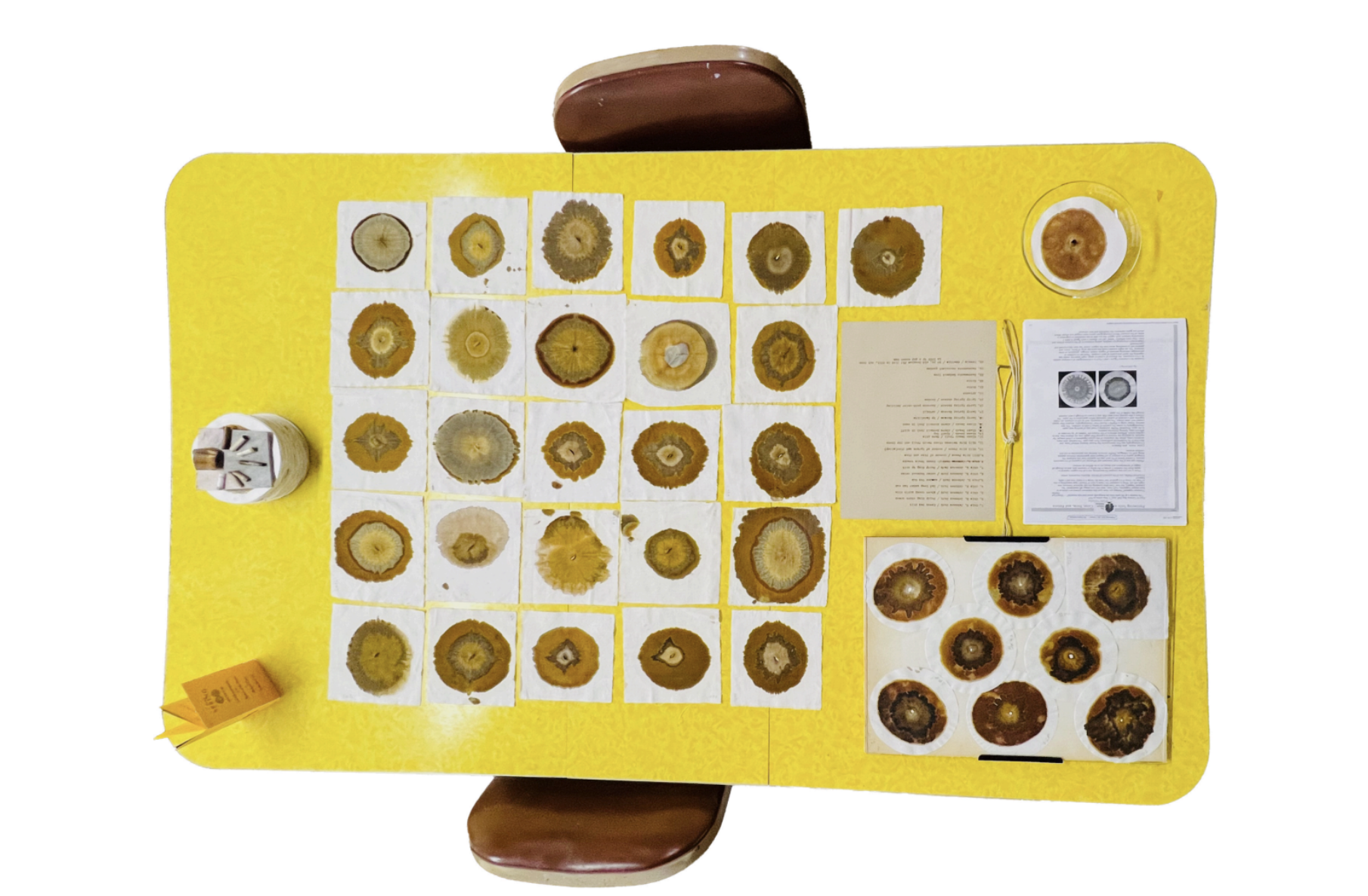
Anne Beck - Redwood Time is a communal re-envisioning of the redwood round monument that stands in the center of Fort Bragg. Emerging from the Larry Spring Museum and carried forth by its magnetic and electrical impulses, Redwood Time has created a 1:1 fabric model of the redwood round as a portal for inquiry. By changing the lens on the portal, we can approach the round from myriad perspectives, including historical, ecological, sociological, environmental, and our favorite, the esoteric. This work with soil chromatography came forth from the latter, as we were seeking the mercurial spirit in the bottle, hidden deep within the earth among the roots of the erstwhile tree. The seekers on this particular venture included Anne Beck, Ursula Brookbank, Anne Maureen McKeating, Shoshana Zambryski-Stachel, and the Larry Spring Museum community.
Redwood Time has received support from California Humanities, Community Foundation of Mendocino County,, Andy Warhol Foundation and Helen Frankenthaler Foundation. It is intended to culminate, as much as anything ever truly culminates, in the Fall of 2026 with a community wide presentation centered in Dry Shed #4 on the Georgia Pacific Mill Site.